
Bugak
In today's article we are going to delve into the fascinating world of Bugak. We will explore its origins, its impact on society and the relevance it has had over time. Bugak is a topic that never ceases to surprise us, its influence extends to different areas and has managed to capture the attention of people of all ages. Join us on this adventure as we unravel the secrets and curiosities that Bugak has to offer us. Get ready to immerse yourself in a journey full of discoveries!
 Dasima-bugak (deep-fried kelp) | |
| Type | Fritter |
|---|---|
| Place of origin | Korea |
| Associated cuisine | Korean cuisine |
| Korean name | |
| Hangul | 부각 |
| RR | bugak |
| MR | pugak |
| IPA | pu.ɡak̚ |
| This article is part of a series on |
| Korean cuisine 한국 요리 조선 료리 |
|---|
.jpg) |
Bugak (부각) is a variety of vegetarian twigim (deep-fried dish) in Korean cuisine.[1] It is made by deep frying dried vegetables or seaweed coated with chapssal-pul (찹쌀풀; glutinous rice paste) and then drying them again.[2] It is eaten as banchan (accompaniment to cooked rice) or anju (accompaniment to alcoholic beverages). Common ingredients are green chili peppers, perilla leaves, perilla inflorescence, camellia leaves, chrysanthemum leaves, burdock leaves, tree of heaven shoots, potatoes, gim (laver), and dasima (kelp). Vegetable oils such as perilla oil or soybean oil are typically used for frying.[3]
Bugak is a relatively rare culinary technique in Korean cuisine, along with dasima twigak (튀각; deep fried vegetables without coating). It is often associated with Korean temple cuisine.[3][4]
Varieties
- dangeun-bugak (당근부각) – made with carrots
- dasima-bugak (다시마부각) – made with kelp
- deulkkae-songi-bugak (들깨송이부각) – made with perilla inflorescence
- dongbaek-ip-bugak (동백잎부각) – made with camellia leaves
- dureup-bugak (두릅부각) – made with angelica tree shoots
- eumnamu-sun-bugak (음나무순부각) – made with castor aralia shoots
- gajuk-bugak (가죽부각) – made with tree of heaven shoots
- gamja-bugak (감자부각) – made with potatoes
- gamnnip-bugak (감잎부각) – made with persimmon leaves
- gim-bugak (김부각) – made with laver
- gochu-bugak (고추부각) – made with green chili peppers
- gukhwa-ip-bugak (국화잎부각) – made with chrysanthemum leaves
- kkaennip-bugak (깻잎부각) – made with perilla leaves
- mosi-ip-bugak (모시잎부각) – made with ramie leaves
- ogapi-ip-bugak (오가피잎부각) – made with eleuthero leaves
- parae-bugak (파래부각) – made with green laver
- ssuk-bugak (쑥부각) – made with Korean mugwort
- ueong-ip-bugak (우엉잎부각) – made with burdock
Gallery
-
 Gim-bugak (deep fried seaweed)
 -
 Gochu-bugak (deep fried chili peppers)
 -
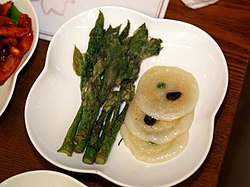 Dureup-bugak (deep fried angelica tree shoots) with chal-jeonbyeong (glutinous rice pancakes)


See also

References
- ^ Mishan, Ligaya (1 May 2014). "Hungry City: Dotory in Williamsburg, Brooklyn". The New York Times. Retrieved 30 May 2017.
- ^ "Twigak and Bugak (fried kelp)". Korea Agro-Fisheries Trade Corporation. Archived from the original on 14 April 2009. Retrieved 21 June 2008.
- ^ a b 서, 혜경. "bugak" 부각. Encyclopedia of Korean Culture (in Korean). Academy of Korean Studies. Retrieved 21 June 2008.
- ^ Yoon, Sook-ja (January 2015). "The taste of time: No country enjoys fermented and preserved foods like Korea". KOREA. Vol. 11, no. 1. Korean Culture and Information Service. p. 11. Retrieved 30 April 2017 – via issuu.
 | This Korean cuisine–related article is a stub. You can help Wikipedia by expanding it. |