
Complete coloring
In this article about Complete coloring we will explore different aspects and perspectives about this broad and relevant topic in today's society. From its origin and evolution, to its implications in different areas of daily life, we will delve into a detailed analysis that will allow us to better understand the multiple dimensions that Complete coloring encompasses. Through research and reflection, we seek to shed light on aspects that are little known or debated, in order to enrich our understanding of Complete coloring and its implications in the contemporary world.

In graph theory, a complete coloring is a (proper) vertex coloring in which every pair of colors appears on at least one pair of adjacent vertices. Equivalently, a complete coloring is minimal in the sense that it cannot be transformed into a proper coloring with fewer colors by merging pairs of color classes. The achromatic number ψ(G) of a graph G is the maximum number of colors possible in any complete coloring of G.
A complete coloring is the opposite of a harmonious coloring, which requires every pair of colors to appear on at most one pair of adjacent vertices.
Complexity theory
Finding ψ(G) is an optimization problem. The decision problem for complete coloring can be phrased as:
- INSTANCE: a graph G = (V, E) and positive integer k
- QUESTION: does there exist a partition of V into k or more disjoint sets V1, V2, …, Vk such that each Vi is an independent set for G and such that for each pair of distinct sets Vi, Vj, Vi ∪ Vj is not an independent set.
Determining the achromatic number is NP-hard; determining if it is greater than a given number is NP-complete, as shown by Yannakakis and Gavril in 1978 by transformation from the minimum maximal matching problem.[1]
Note that any coloring of a graph with the minimum number of colors must be a complete coloring, so minimizing the number of colors in a complete coloring is just a restatement of the standard graph coloring problem.
Algorithms
For any fixed k, it is possible to determine whether the achromatic number of a given graph is at least k, in linear time.[2]
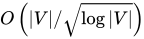
The optimization problem permits approximation and is approximable within a approximation ratio.[3]
Special classes of graphs
The NP-completeness of the achromatic number problem holds also for some special classes of graphs: bipartite graphs,[2] complements of bipartite graphs (that is, graphs having no independent set of more than two vertices),[1] cographs and interval graphs,[4] and even for trees.[5]
For complements of trees, the achromatic number can be computed in polynomial time.[6] For trees, it can be approximated to within a constant factor.[3]
The achromatic number of an n-dimensional hypercube graph is known to be proportional to , but the constant of proportionality is not known precisely.[7]

References
- ^ a b Michael R. Garey and David S. Johnson (1979), Computers and Intractability: A Guide to the Theory of NP-Completeness, W.H. Freeman, ISBN 978-0-7167-1045-5 A1.1: GT5, pg.191.
- ^ a b Farber, M.; Hahn, G.; Hell, P.; Miller, D. J. (1986), "Concerning the achromatic number of graphs", Journal of Combinatorial Theory, Series B, 40 (1): 21–39, doi:10.1016/0095-8956(86)90062-6.
- ^ a b Chaudhary, Amitabh; Vishwanathan, Sundar (2001), "Approximation algorithms for the achromatic number", Journal of Algorithms, 41 (2): 404–416, CiteSeerX 10.1.1.1.5562, doi:10.1006/jagm.2001.1192, S2CID 9817850.
- ^ Bodlaender, H. (1989), "Achromatic number is NP-complete for cographs and interval graphs", Inf. Process. Lett., 31 (3): 135–138, doi:10.1016/0020-0190(89)90221-4, hdl:1874/16576.
- ^ Manlove, D.; McDiarmid, C. (1995), "The complexity of harmonious coloring for trees", Discrete Applied Mathematics, 57 (2–3): 133–144, doi:10.1016/0166-218X(94)00100-R.
- ^ Yannakakis, M.; Gavril, F. (1980), "Edge dominating sets in graphs", SIAM Journal on Applied Mathematics, 38 (3): 364–372, doi:10.1137/0138030.
- ^ Roichman, Y. (2000), "On the Achromatic Number of Hypercubes", Journal of Combinatorial Theory, Series B, 79 (2): 177–182, doi:10.1006/jctb.2000.1955.