
Lambda Mensae
In this article, we will delve into the fascinating world of Lambda Mensae. From its origins to its relevance today, we will explore the most important aspects related to this topic. We will consider its impact on society, its influence in various areas, as well as the challenges and opportunities it presents. Along these lines, we will immerse ourselves in an exhaustive analysis that will allow us to understand the importance and scope of Lambda Mensae, offering a complete and updated vision of this topic that is so relevant today.
| Observation data Epoch J2000.0 Equinox J2000.0 (ICRS) | |
|---|---|
| Constellation | Mensa |
| Right ascension | 05h 47m 48.13340s[1] |
| Declination | −72° 42′ 08.0993″[1] |
| Apparent magnitude (V) | 6.53[2] |
| Characteristics | |
| Evolutionary stage | red clump[3] |
| Spectral type | K0 III[4] |
| Apparent magnitude (B) | 7.614[5] |
| Apparent magnitude (J) | 4.820[3] |
| Apparent magnitude (H) | 4.163[3] |
| Apparent magnitude (K) | 4.119[3] |
| U−B color index | +0.97[2] |
| B−V color index | +1.08[2] |
| Astrometry | |
| Radial velocity (Rv) | 15.35±0.13[6] km/s |
| Proper motion (μ) | RA: -7.013[6] mas/yr Dec.: +24.451[6] mas/yr |
| Parallax (π) | 6.9890±0.0139 mas[6] |
| Distance | 466.7 ± 0.9 ly (143.1 ± 0.3 pc) |
| Absolute magnitude (MV) | +0.84[7] |
| Details | |
| Radius | 10[8] R☉ |
| Luminosity | 54[9] L☉ |
| Surface gravity (log g) | 2.43[10] cgs |
| Temperature | 4,713[10] K |
| Other designations | |
| λ Men, CPD−72°289, HD 39810, HIP 27369, HR 2062, SAO 256239, 2MASS J05474813-7242080[11] | |
| Database references | |
| SIMBAD | data |
Lambda Mensae, Latinized from λ Mensae, is an orange-hued star in the southern constellation of Mensa. It has an apparent visual magnitude of 6.53,[2] which places it at or near the limit on stars visible to the naked eye. According to the Bortle scale, it requires a dark night from rural skies for this star to be viewed. Though it has the designation Lambda, it is actually the twenty-fourth-brightest star in the constellation and not the eleventh-brightest.
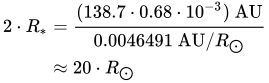
This is an evolved K-type giant star with a stellar classification of K0 III.[4] It is a red clump star, which means it is generating energy through helium fusion at its core.[3] The measured angular diameter is 0.68±0.01 mas.[12] At an estimated distance of the star, this yields a physical size of about 10 times the radius of the Sun.[8] It is radiating 54[9] times the Sun's luminosity from its enlarged photosphere at an effective temperature of 4,713 K.[10]
References
- ^ a b van Leeuwen, F. (2007), "Validation of the new Hipparcos reduction", Astronomy and Astrophysics, 474 (2): 653–664, arXiv:0708.1752, Bibcode:2007A&A...474..653V, doi:10.1051/0004-6361:20078357, S2CID 18759600.
- ^ a b c d Johnson, H. L.; et al. (1966), "UBVRIJKL photometry of the bright stars", Communications of the Lunar and Planetary Laboratory, 4 (99): 99, Bibcode:1966CoLPL...4...99J.
- ^ a b c d e Laney, C. D.; et al. (January 2012), "A new Large Magellanic Cloud K-band distance from precision measurements of nearby red clump stars", Monthly Notices of the Royal Astronomical Society, 419 (2): 1637–1641, arXiv:1109.4800, Bibcode:2012MNRAS.419.1637L, doi:10.1111/j.1365-2966.2011.19826.x, S2CID 117788450.
- ^ a b Houk, Nancy; Cowley, A. P. (1979), Michigan catalogue of two-dimensional spectral types for the HD stars, vol. 1, Ann Arbor, Michigan: Dept. of Astronomy, University of Michigan, Bibcode:1978mcts.book.....H.
- ^ Høg, E.; et al. (2000), "The Tycho-2 catalogue of the 2.5 million brightest stars", Astronomy and Astrophysics, 355: L27, Bibcode:2000A&A...355L..27H, doi:10.1888/0333750888/2862.
- ^ a b c d Brown, A. G. A.; et al. (Gaia collaboration) (2021). "Gaia Early Data Release 3: Summary of the contents and survey properties". Astronomy & Astrophysics. 649: A1. arXiv:2012.01533. Bibcode:2021A&A...649A...1G. doi:10.1051/0004-6361/202039657. S2CID 227254300. (Erratum: doi:10.1051/0004-6361/202039657e). Gaia EDR3 record for this source at VizieR.
- ^ Anderson, E.; Francis, Ch. (2012), "XHIP: An extended hipparcos compilation", Astronomy Letters, 38 (5): 331, arXiv:1108.4971, Bibcode:2012AstL...38..331A, doi:10.1134/S1063773712050015, S2CID 119257644.
- ^ a b Lang, Kenneth R. (2006), Astrophysical formulae, Astronomy and astrophysics library, vol. 1 (3rd ed.), Birkhäuser, ISBN 3-540-29692-1. The radius (R*) is given by:
- ^ a b McDonald, I.; et al. (2012), "Fundamental Parameters and Infrared Excesses of Hipparcos Stars", Monthly Notices of the Royal Astronomical Society, 427 (1): 343–57, arXiv:1208.2037, Bibcode:2012MNRAS.427..343M, doi:10.1111/j.1365-2966.2012.21873.x, S2CID 118665352.
- ^ a b c Kordopatis, G.; Gilmore, G.; Steinmetz, M.; Boeche, C.; Seabroke, G. M.; Siebert, A.; Zwitter, T.; Binney, J.; et al. (November 2013), "The Radial Velocity Experiment (RAVE): Fourth Data Release", The Astronomical Journal, 146 (5): 36, arXiv:1309.4284, Bibcode:2013AJ....146..134K, doi:10.1088/0004-6256/146/5/134, S2CID 119221010, 134.
- ^ "lam Men". SIMBAD. Centre de données astronomiques de Strasbourg. Retrieved 2017-08-15.
{{cite web}}: CS1 maint: postscript (link) - ^ Richichi, A.; et al. (February 2005), "CHARM2: An updated Catalog of High Angular Resolution Measurements", Astronomy and Astrophysics, 431 (2): 773–777, Bibcode:2005A&A...431..773R, doi:10.1051/0004-6361:20042039.
| Stars |
| ||||||||||
|---|---|---|---|---|---|---|---|---|---|---|---|
| |||||||||||
| Star clusters |
| ||||||||||
| |||||||||||
| Galaxies |
| ||||||||||
