
Languages of Namibia
In this article we are going to explore Languages of Namibia and its impact on different aspects of everyday life. Languages of Namibia has been the subject of interest and debate for a long time, and its influence extends to multiple areas, from politics to popular culture. We'll dive into the different aspects that make Languages of Namibia a relevant and interesting topic, and analyze how it has evolved over time. From its origin to its current relevance, we will dive into a complete analysis of Languages of Namibia and its importance in our society.
| Languages of Namibia | |
|---|---|
 | |
| Official | English |
| National | Afrikaans, German, Otjiherero, Khoekhoegowab, Oshiwambo, RuKwangali, Setswana, SiLozi |
| Recognised | !Kung, Gciriku, Thimbukushu |
| Vernacular | Namlish, Namibian Afrikaans, Namibian German |
| Minority | Fwe, Kuhane, Mbukushu, Yeyi, Naro, ǃXóõ ǂKxʼauǁʼein |
| Immigrant | Portuguese |
| Signed | Namibian Sign Language |
| Keyboard layout | |

Namibia, despite its scant population, is home to a wide diversity of languages, from multiple language families: Germanic, Bantu, and the various Khoisan families. Afrikaans, German, and English had equal status as official languages during the time Namibia was administered by South Africa. Upon Namibian independence in 1990, English was enshrined as the nation's sole official language in the constitution of Namibia. German and Afrikaans were stigmatised as relics of the colonial past,[1] while the rising of Mandela's Youth League and the 1951 Defiance Campaign spread English among the masses as the language of the campaign against apartheid.[2]
Language demographics

The most widely spoken languages are Oshiwambo dialects by 49% of households in the country, then Khoekhoegowab by 11%; Afrikaans by 10%; RuKwangali by 9%; Otjiherero by 9%, and Silozi by 4.71%.[3] Other languages include the Bantu languages Setswana, Gciriku, Fwe, Kuhane, Mbukushu, Yeyi; and the Khoisan Naro, ǃXóõ, Kung-Ekoka, ǂKxʼauǁʼein and Kxoe.[4]
English, the sole official language, is spoken by 3.4% of people as their native language.
As of 2014 Portuguese was spoken by 4–5% of the total population, made up mostly of the Angolan community.[5] Although the number of Angolans in Namibia declined from 2014 to 2015, affected by the neighbouring country's economic crisis, there are still around 100,000 Portuguese speakers in Namibia as of 2024, equivalent to 3.3% of the country's population.[6][7][8] The language is now offered as an optional subject in many schools throughout the country.[9]
Indigenous languages are included in the school syllabus at primary level. From secondary level English is the medium of instruction. English is the main lingua franca in the north and Afrikaans (Namibian Afrikaans) in the south. English and Afrikaans are both widely spoken in Windhoek.[10]
-
 Distribution of Khoekhoegowab
 -
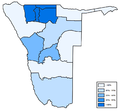 Distribution of Oshiwambo
 -
 Distribution of Khoekhoegowab
 -
 Distribution of Namibian Afrikaans
.svg)

_in_Namibia.png)

-
 Distribution of Otjiherero
 -
 Distribution of Kavango languages
 -
 Distribution of Silozi[11]


Languages most often spoken in Namibian households
| Main language | 2001 | 2011 |
|---|---|---|
| Oshiwambo | 48.5 | 48.9 |
| Khoekhoegowab | 11.5 | 11.3 |
| Afrikaans | 11.4 | 10.4 |
| Otjiherero | 7.9 | 8.6 |
| RuKwangali | 9.7 | 8.5 |
| Silozi | 5.0 | 4.8 |
| English | 1.9 | 3.4 |
| German | 1.1 | 0.9 |
| San | 1.2 | 0.8 |
| Other | 1.8 | 2.4 |
Source: 2001 Census[12] and 2011 Census[13]
See also
References
- ^ "Namibia Travel Guide". Retrieved 8 July 2010.
- ^ Brutt-Griffler, J. (2002). World English: a study of its development. Multilingual Matters, p.165. ISBN 1853595772
- ^ "Languages Spoken - GRN Portal". www.gov.na. Archived from the original on 2017-03-06. Retrieved 2018-04-22.
- ^ Lewis, M. Paul, ed. (2009). Ethnologue: Languages of the World, Sixteenth edition. SIL International.
- ^ "Portuguese to be introduced in schools". The Namibian. Archived from the original on 24 February 2014. Retrieved 19 February 2014.
- ^ "Opinion - Celebrating with Namibia the Legacy of the Portuguese Language".
- ^ "Celebrating Portuguese - Desert Radio". 2024-05-06. Retrieved 2024-06-14.
- ^ Marketing, Intouch Interactive. "Angolan tourists on the decline - Tourism - Namibian Sun". Retrieved 2018-04-22.
- ^ "Namibia and Portugal renews relations | Namibia Economist". Retrieved 2024-06-14.
- ^ Discrimination through language in Africa?: perspectives on the Namibian experience. Walter de Gruyter, p. 315. ISBN 311014817X
- ^ "Zambezi Region | Caprivi Strip | Namibia". www.namibian.org. Retrieved 2018-04-22.
- ^ "2001 Census" (PDF). Archived from the original (PDF) on Sep 3, 2014.
- ^ "2011 Census" (PDF). Archived from the original (PDF) on Oct 2, 2013.