
Makenyats Vank
In today's article we are going to delve into the fascinating world of Makenyats Vank. From its origins to its relevance today, we will explore all the relevant aspects of this topic. We will learn about its impact on society, its influence in different areas and the possible future implications. Through a comprehensive analysis, we will discover how Makenyats Vank has managed to capture the attention of millions of people around the world and has left a significant mark on history. Get ready to embark on a journey of discovery and learning about Makenyats Vank.
| Makenyats Vank Մաքենյաց վանք | |
|---|---|
 | |
| Religion | |
| Affiliation | Armenian Apostolic Church |
| Location | |
| Location | Makenis, Gegharkunik Province, Armenia |
  Shown within Armenia  Makenyats Vank (Gegharkunik) | |
| Coordinates | 40°07′30″N 45°36′48″E / 40.125060°N 45.613259°E |
| Architecture | |
| Style | Armenian |
| Completed | 9th–13th centuries |
| Dome | 1 |
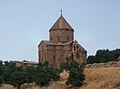
Makenyats Vank (Armenian: Մաքենյաց վանք) is a 9th–13th century Armenian monastery located 5 kilometres (3.1 mi) south of Lake Sevan in the village of Makenis in the Gegharkunik Province of Armenia. The monastery was founded in 851 with the construction of the central S. Astvatsatsin Church by Prince Grigor Supan II, the son of Princess Mariam, who was also the founder of Kotavank in Nerkin Getashen, Armenia. Makenyats Vank served as a major cultural and educational center for the medieval province of Gegharkunik.
Architecture
The main church of S. Astvatsatsin is cruciform in plan, with a conical dome supported by a circular tholobate below. Four windows pierce the walls of the tholobate, letting some light into the church interior. A large horse carved in bas-relief adorns the interior basalt lintel of the main portal to the church.
A single cupola rests over the southwest entry. Numerous khachkars have been placed along the walls of the Church as well as the outer walls enclosing the monastery. A cemetery encompasses the church, especially around the western end, with both medieval and contemporary graves. Along the outer wall, along the gorge to the southwest corner, there is a medieval sanitary facility.
Gallery
-
 Makenyats Vank
 -
 Panoramic view of Makenyats Vank
 -
 Cupola
 -
 Perimeter wall surrounding the monastery.
 -
 Khachkars lining the exterior wall of the church.
 -
 Large khachkar to the left of the main entry to the church.
 -
 Large low-relief depiction on the interior side of the stone lintel above the entry.
 -
 Large low-relief depiction on the interior side of the stone lintel above the entry.


External links



  | This article about an Armenian Christian monastery, abbey, priory or other religious house is a stub. You can help Wikipedia by expanding it. |